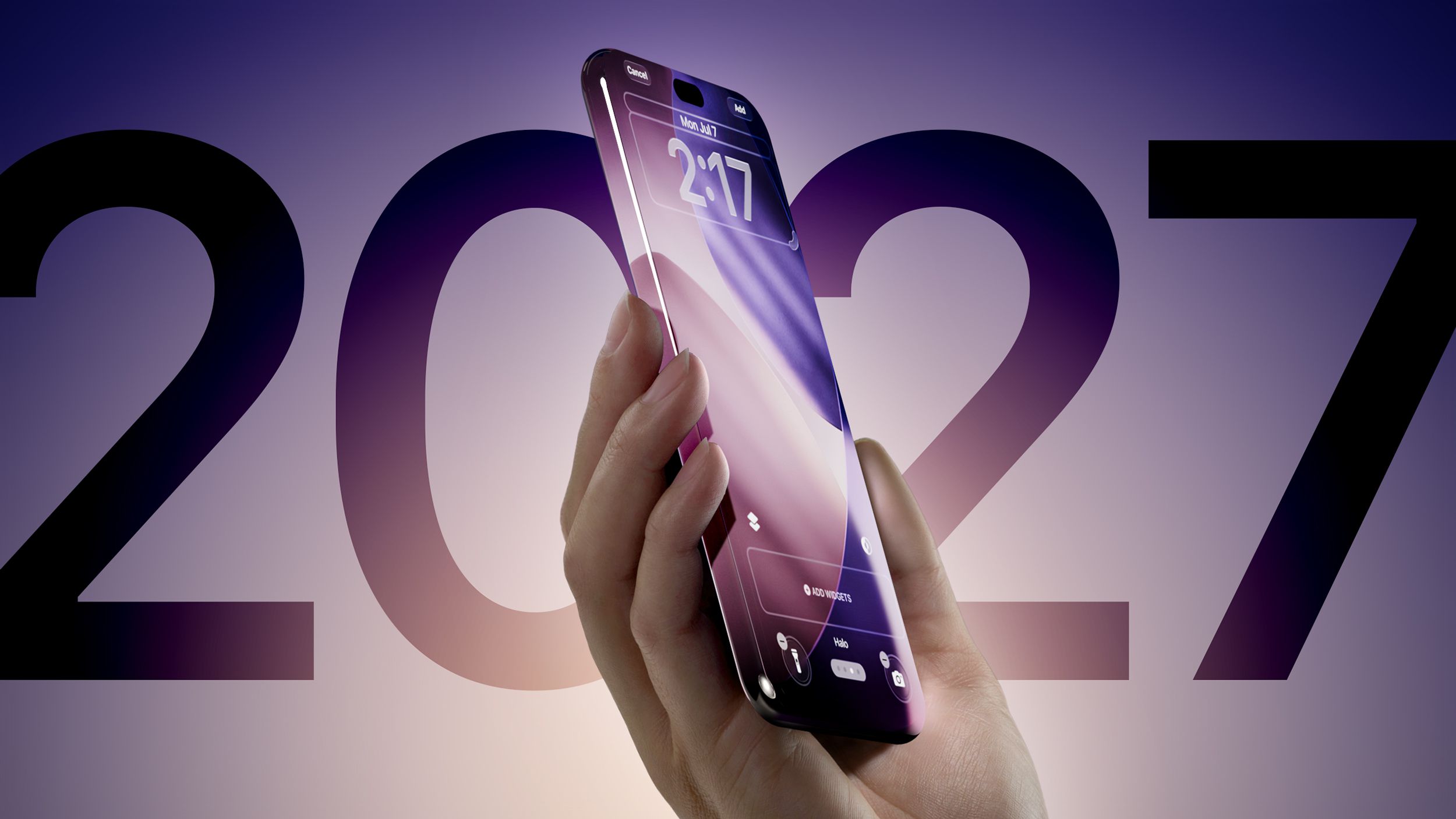
Apple is reportedly planning a radical redesign for its 20th anniversary iPhone, expected in 2027, featuring a "Liquid Glass Display" that curves on all four edges to create a virtually bezel-less experience. This overhaul will likely involve a custom micro-curved OLED panel from Samsung, incorporating advanced COE technology for a brighter and thinner screen. The ambition is a truly all-screen device, though challenges remain in fully concealing Face ID and the front camera.
A Vision of "Liquid Glass" and Bezel-less Design
Apple is reportedly preparing a significant aesthetic overhaul for its 20th anniversary iPhone, slated for release in 2027, with rumors pointing to a radical redesign centered around a "Liquid Glass Display". This innovative display technology is expected to feature a screen that subtly curves around all four edges of the device, aiming to create a virtually bezel-less viewing experience. The visual impact is anticipated to be achieved through a sophisticated combination of optical refraction, light guiding structures, and carefully engineered visual illusions, making the bezels nearly disappear from sight.
To realize this ambitious vision, Apple is reportedly collaborating with
Samsung Display to produce a custom micro-curved OLED panel. This panel will utilize an "equal-depth quad-curved" design, distinct from the more aggressive "waterfall" curves seen on some Android devices. The goal is a subtle curvature that maintains a natural and undisturbed edge viewing experience.
Advanced Display Technology for Enhanced Visuals
Beyond the striking curvature, the 20th anniversary
iPhone is expected to incorporate advanced display technologies to enhance its visual performance. A key component is
Samsung's COE (Color Filter on Encapsulation) OLED technology. This innovation removes the traditional polarizer layer from the OLED panel, applying the color filter directly onto the encapsulation layer.
The adoption of COE technology offers several significant advantages:
- It reduces the overall thickness of the display stack, contributing to a thinner device.
- It allows more light to pass through, resulting in improved brightness.
- It minimizes power consumption, potentially leading to better battery life.
Apple is also reportedly considering a crater-shaped light diffusion layer within the display to ensure uniform illumination across the entire screen.
The Quest for a True All-Screen Experience
The ultimate ambition for the 20th anniversary
iPhone is a truly all-screen design, where no visible sensors or cutouts interrupt the display. This would mean integrating both the
Face ID system and the front-facing camera beneath the display. While this has been a long-standing goal for Apple, achieving it presents significant technical challenges.
Some reports suggest that while under-display
Face ID might be ready for the 2027 iPhone, the under-display selfie camera could still be a hurdle, potentially leading to a small hole-punch cutout for the camera if full under-display integration isn't feasible. Despite these potential roadblocks, Apple continues to test various design ideas for this anniversary model, aiming for a device that embodies the "single slab of glass" ideal.
Beyond the Display: Performance and Power
While the display is a major focus, the 20th anniversary
iPhone is also expected to feature advancements in performance and power. It will likely utilize a second-generation
2-nanometer A-series chip, following the anticipated A20 chips in the
iPhone 18 lineup. This would position the anniversary model to potentially feature an
A21 chip, offering significant processing power.
Furthermore, Apple is reportedly developing new battery technology, exploring the use of pure silicon anode batteries. These batteries have the potential to store more lithium ions per gram than current batteries, which could lead to substantial increases in battery life without significantly increasing battery size.