
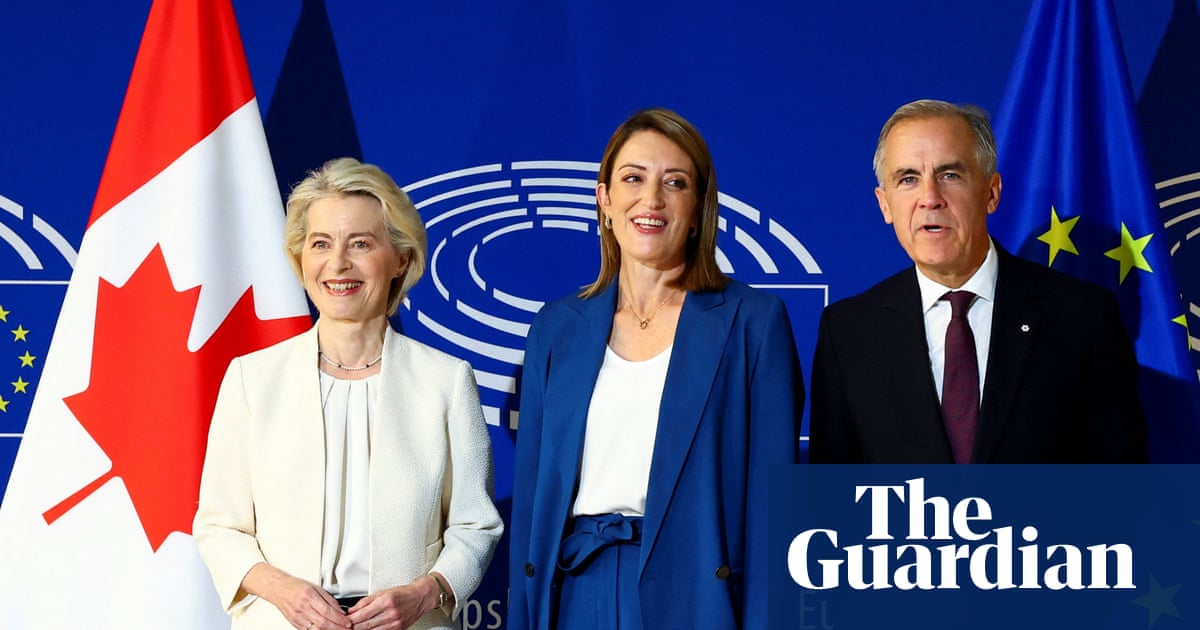
European Commission President Ursula von der Leyen proposed on Wednesday to open the door for Canada to become the European Union's first associate member, delivering an unprecedented overture inside the European Parliament hemicycle in Strasbourg. Seated in the front row as a guest of honor, Canadian Prime Minister Mark Carney rose to embrace von der Leyen as European lawmakers gave the announcement a standing ovation[1].
The overture marks a dramatic realignment attempt by both powers as transatlantic relationships fracture under U.S. President Donald Trump. With Ottawa navigating aggressive U.S. tariffs and persistent rhetoric from Washington questioning its autonomy, Canada has sought to rapidly diversify its economic and geopolitical footprint away from its southern neighbor, which still absorbs roughly 70 percent of Canadian goods.
An Alliance for the Future
Addressing the European Parliament during her annual State of the European Union address, von der Leyen framed the initiative as a necessary response to an increasingly fragmented global order. The Commission president stated that democracies are navigating acute instability and urged democratic allies to redesign traditional frameworks.
I would like to work with you on opening the door for Canada to be the first associate member of the EU.
Ursula von der Leyen, European Commission President
Von der Leyen proposed moving beyond the bilateral Comprehensive Economic and Trade Agreement, known as CETA, toward what she designated an Alliance for the Future. As reported by The Washington Post and CTV News, the envisioned partnership would build a common prosperity and economic security space spanning several critical sectors[7]:
- Integration of Canadian and European defense industrial bases to fortify transatlantic security.
- Joint ventures on critical minerals extraction and refining to curb dependence on external supply chains.
- A strategic technology pact focusing on artificial intelligence governance, research, and deployment[7].
- Shared scientific and security initiatives targeting the Arctic and energy resilience.
Carney welcomed the gesture, stating on social media that Canada and the European Union are natural partners united by core democratic values. While the Canadian leader previously sought to clarify that Ottawa is not pursuing full membership inside the 27-nation bloc, Canadian officials confirmed to The Associated Press that Ottawa had explored options stopping just short of full membership, including arrangements that could grant visa-free mobility for Canadian and European citizens to live and work across borders.
Geopolitical Friction With Washington
The European overture follows months of escalating trade tension between Washington and Ottawa. After a breakdown in bilateral negotiations with the White House, the Trump administration slapped sweeping tariffs on Canadian exports, prompting Canada to reconsider its deep trade exposure. Trump's repeated public quips regarding Canada becoming the fifty-first U.S. state have further inflamed relations, propelling Carney to look across the Atlantic to protect Canadian sovereignty[1].
The geopolitical reorientation is not confined to Brussels. Amid the standoff with the White House, Canada has moved to mend commercial dialogue with other global powers, including China, where officials recently resumed formal military discussions following an eight-year freeze, as noted by The Washington Post. In Brussels, however, the alignment is explicitly rooted in common democratic norms, with von der Leyen stressing to lawmakers that power must not belong solely to the strongest or the richest.

Legal Ambiguity and European Hurdles
Despite the enthusiastic reception in Strasbourg, the proposal faces formidable diplomatic and institutional obstacles. The European Union treaties contain no formal definition or mechanism for an associate member status. Any structural creation of this rank would necessitate unanimous approval from all 27 EU member states, a bar that has stalled similar ambitions in the past.
| Dimension | Existing Framework (CETA) | Proposed Associate Framework |
|---|---|---|
| Legal Basis | Bilateral free trade treaty (provisionally applied) | Undefined in EU founding treaties; requires unanimous approval[7] |
| Defense Cooperation | Ad hoc coordination via NATO | Formal integration of defense manufacturing and industrial base |
| Mobility of Persons | Standard national visa requirements | Proposed reciprocal rights to live and work without visas |
| Strategic Focus | Tariff elimination on commercial goods[13] | Critical minerals, Arctic sovereignty, and AI alignment |
European capitals have previously bristled at creating tiered membership models. Reuters reported that when German Chancellor Friedrich Merz floated associate status earlier this year as an interim milestone for Ukraine, the plan drew friction from member capitals worried about diluting the union's core treaties and met resistance in Kyiv. Following von der Leyen's speech, one European diplomat told Reuters that nobody really knows what the proposal means in practical terms, cautioning that the European Commission chief risks overpromising policies that member states cannot unanimously deliver[8].
Unresolved bilateral trade disputes also complicate swift integration. Although CETA has provisionally eliminated 99 percent of customs tariffs since 2017, ten European member states—including France, Italy, and Poland—have yet to fully ratify the agreement in their national parliaments, according to the Financial Times. Domestic critics within Canada have additionally questioned whether closer regulatory ties might subject Canadian exporters to burdensome carbon border taxes and stringent European directives.
Carney is scheduled to address the European Parliament on Thursday morning to outline his vision of the transatlantic alliance directly to European deputies, ahead of a planned EU-Canada bilateral summit in late October where both sides will attempt to turn symbolic enthusiasm into formal policy.