A New Era of AI Image Generation
The landscape of artificial intelligence image generation is rapidly evolving, with OpenAI's recent release of ChatGPT Images 2.0 marking a substantial advancement. This new iteration goes beyond basic image creation, incorporating the ability to include text and context derived from real data. In head-to-head comparisons, ChatGPT Images 2.0 has shown a dramatic improvement, particularly in its ability to understand and execute complex prompts with greater precision.
Previously, Google's Gemini Nano Banana (also referred to as Nano Banana 2) held a strong position in the market, scoring an impressive 93% in tests conducted in December 2025, compared to ChatGPT's then-disappointing 74%. However, recent re-evaluations have seen a reversal of fortunes, with ChatGPT Images 2.0 achieving a 97% score, while Nano Banana's score dropped to 85%. This indicates a significant shift in the capabilities of OpenAI's offering.
Precision Versus Personality: A Tale of Two Models
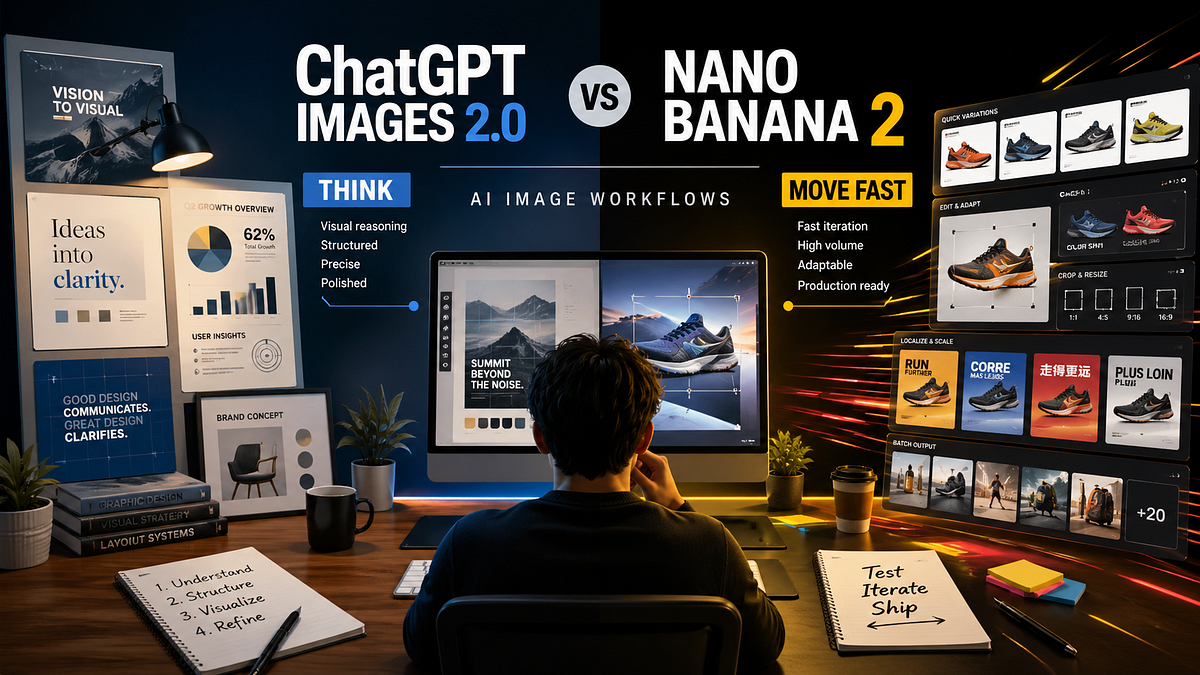
One of the most striking differences highlighted in recent tests is the distinct "personality" of each AI model. ChatGPT Images 2.0 consistently demonstrates a focus on precision, adhering strictly to prompts and delivering exactly what is requested. This makes it particularly adept at tasks requiring accurate layouts, legible text, and internal coherence, such as editorial layouts, magazine covers, and technical infographics. For instance, in a test involving a vintage apothecary shelf with labeled bottles, ChatGPT Images 2.0 nailed the atmosphere, lighting accuracy, and text legibility, making a photographically correct image.
Conversely, Nano Banana 2 often exhibits a tendency to go beyond the explicit prompt, adding elements or interpretations that were not explicitly requested. While this can sometimes lead to creative and "alive" results, it can also result in deviations from the intended output. For example, in a test to change a lawn's season to autumn, Nano Banana 2 provided a cleaner, more uniform transformation, but not all trees changed color, whereas ChatGPT's version showed unevenness and scattered leaves, feeling more natural. Nano Banana 2 also stumbled on text and prompt discipline in some scenarios.
Performance Across Key Use Cases
Text Rendering and Layout
ChatGPT Images 2.0 has made significant strides in rendering fine text and complex layouts. It excels when prompts require layout logic, legible text, and internal coherence, making it the preferred tool for graphic design-sensible work. In tests involving infographics and presentation creation, ChatGPT Images 2.0 produced minimalistic and visually appealing results with perfectly placed text, unlike Nano Banana 2, which sometimes had text spilling over containers.
Photorealism and Editing
While ChatGPT Images 2.0 has improved dramatically in overall image generation, Nano Banana 2 still holds an advantage in certain aspects of photorealism and photo editing. Nano Banana 2 is built for resolution and reference-driven composition, often producing images with a more polished, commercial style. It also preserves resolution better (1500+ px wide compared to OpenAI's 1024 cap) and runs significantly faster for photo editing tasks. However, ChatGPT Images 2.0's outputs often feel "more real" due to its attention to how light behaves and how textures interact.
Speed and Workflow Integration
When it comes to speed, Nano Banana 2 generally outperforms ChatGPT Images 2.0. Nano Banana 2 can generate images in 11-24 seconds, while ChatGPT Images 2.0, especially with its "thinking" step enabled, can take between 97 and 149 seconds per image. This speed difference is a crucial factor for workflows requiring high-volume output or rapid iterations. Despite the speed disparity, the ability of ChatGPT Images 2.0 to generate up to eight consistent images from a single prompt offers a significant workflow shift for tasks like storyboarding or creating character-consistent series.
The Evolving Competitive Landscape
The competition between OpenAI and Google in the AI image generation space is intensifying. OpenAI's release of ChatGPT Images 2.0, alongside its latest frontier model GPT-5.5, demonstrates a concerted effort to push the boundaries of AI capabilities. While Nano Banana has historically dominated the AI image generator list, ChatGPT Images 2.0 has now emerged as a strong contender, with benchmark scores indicating its supremacy in overall image generation. The choice between the two models often depends on the specific use case: precision and complex text for ChatGPT Images 2.0, or speed and photorealism for Nano Banana 2. Many creators may find themselves utilizing both tools to leverage their respective strengths.