In a direct clash between municipal racial justice initiatives and federal civil rights enforcement, the Department of Justice has moved to intervene in a federal class action lawsuit to halt the nation first municipal reparations program in Evanston, Illinois. The legal offensive targets the Chicago suburb landmark Local Reparations Restorative Housing Program, which awards $25,000 grants to eligible Black residents harmed by decades of municipal segregation and redlining[4] [5].
The intervention marks an escalating federal campaign by the Donald Trump administration to eradicate race conscious policies at the state and local levels. Federal attorneys argue that Evanston exclusionary criteria violate the United States Constitution. Evanston officials, meanwhile, insist that the program remedies quantifiable, state sponsored housing injuries and have pledged to continue disbursing funds while the legal battle unfolds in court.
The Federal Challenge and the Equal Protection Claim
The Justice Department filed its motion to intervene in the U.S. District Court for the Northern District of Illinois, joining an existing civil rights lawsuit initiated by the conservative legal foundation Judicial Watch. That original action, Flinn v. City of Evanston, was filed on behalf of six non-Black individuals whose ancestors lived in Evanston during the targeted era but who were excluded from receiving benefits because of their race[1].
According to federal court filings, the government alleges that the city program violates the Equal Protection Clause of the Fourteenth Amendment and breaches the Fair Housing Act by utilizing racial identity as an explicit prerequisite for financial and housing assistance. In a public statement announcing the motion, Assistant Attorney General Harmeet K. Dhillon of the Justice Department Civil Rights Division denounced the initiative:
Simply handing out money based on race, however, is not the answer. It is race discrimination, pure and simple. And it is illegal.
Harmeet K. Dhillon, Assistant Attorney General, Justice Department Civil Rights Division
Andrew S. Boutros, the U.S. Attorney for the Northern District of Illinois, stated in court filings that government actions classifying citizens by race are presumptively unconstitutional and divide the citizenry rather than fostering equality. The administration maintains that any governmental assistance must address hardship or poverty neutrally, without explicit racial lineage tests.
A Groundbreaking Municipal Effort Under Siege
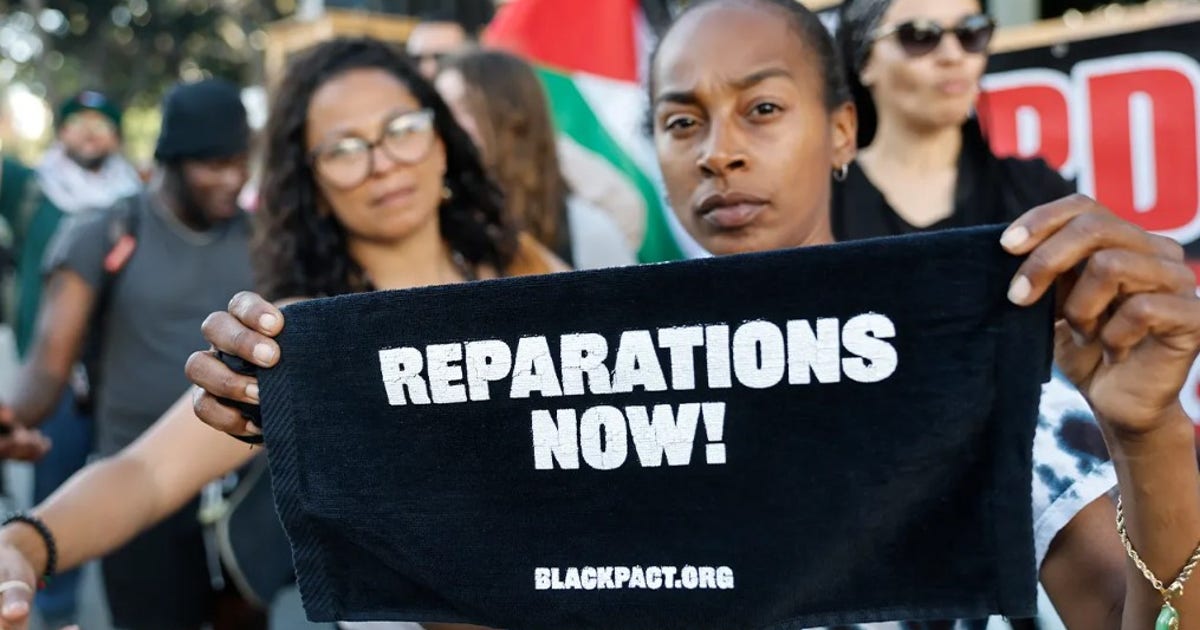
Evanston made national headlines in 2019 and began distributing funds in 2021 as the first municipality in the country to establish a public reparations framework. Designed under the leadership of former alderman Robin Rue Simmons, the initiative dedicated an initial $10 million over ten years, supported heavily by local revenue from a 3 percent sales tax on recreational cannabis alongside real estate transfer taxes[4].
The program was structured to compensate for systemic municipal actions between 1919 and 1969, including a 1921 zoning ordinance that concentrated Black residents into the city Fifth Ward and private lending practices that blocked Black residents from securing standard mortgages. Eligible recipients, including residents who lived through the era as adults and their direct descendants, receive $25,000 payments earmarked for home purchases, mortgage assistance, structural repairs, or direct cash.
- Target era: Documented municipal segregation and redlining enforced between 1919 and 1969[1].
- Current disbursements: More than 300 individuals have received $25,000 grants, representing over $6.3 million in allocated funds.
- Funding mechanism: Municipal revenue generated by local taxes on legal recreational cannabis and property transfers.
- Program goals: Expanding homeownership, closing racial wealth disparities, and reversing historical neighborhood disinvestment[13].
To recipients such as Allie Zemtseff, whose mother was routinely refused rentals in white neighborhoods during the 1960s, the logic of the criteria is undeniable. Zemtseff told NPR that restricting the funding to Black residents is common sense because Black residents endured the documented harm.
Legal Arguments: Remedial Intent Versus Race-Blind Precedent
The lawsuit underscores a profound rift in modern jurisprudence over whether local governments can take race into account when rectifying past racial persecution. Judicial Watch attorney Michael Bekesha argued that previous lawful reparations programs, such as restitution for Japanese Americans interned during World War II or victims of police torture in Chicago, compensated specific, proven individual victims. Bekesha contended that Evanston distributed broad municipal payments based solely on ancestral racial ancestry without requiring each claimant to demonstrate personal city inflicted injury[9].
| Legal Stance | Key Arguments | Statutory and Constitutional Basis |
|---|---|---|
| Trump Administration and Plaintiffs | Government disbursements based on ancestry or race are presumptively invalid; excluding non-Black residents constitutes unlawful bias. | Fourteenth Amendment Equal Protection Clause, Fair Housing Act |
| City of Evanston and Legal Defense | Remedies target specific local legislation and zoning that exclusively segregated Black residents between 1919 and 1969. | Local municipal authority, remedial equity frameworks |
Evanston defense attorneys and civil rights scholars strongly dispute the idea that the policy constitutes reverse discrimination. Justin Hansford, a Howard University law professor assisting Evanston with its legal defense, told Democracy Now that the lawsuit aims to intimidate cities that are constructing similar models. Hansford noted that generations of housing denial generated wide wealth gaps, and the city policies directly inflicted that dispossession.
Evanston has also urged the federal district court to dismiss the underlying Judicial Watch lawsuit on standing grounds. City attorneys noted that the individual plaintiffs never applied to the program before the formal application window closed, arguing that the court lacks jurisdiction to hear their complaint.
National Implications for the Reparations Movement
Across the United States, municipal and state task forces from California to New York have looked to Evanston as a workable template for local restorative justice. By striking at Evanston, the federal government seeks to establish a precedent that could halt municipal reparations nationwide before they gain broader traction[4].
Northwestern University professor Alvin Tillery cautioned in remarks reported by NPR that the case holds existential stakes for public policy. Tillery warned that if courts conclude that local governments cannot explicitly direct relief to communities damaged by racist public policies, local equity initiatives nationwide could be completely paralyzed. As District Judge John F. Kness weighs the Justice Department intervention and the city motion to dismiss, Evanston remains defiant, declaring that its payments will continue until a court issues an explicit order to stop.