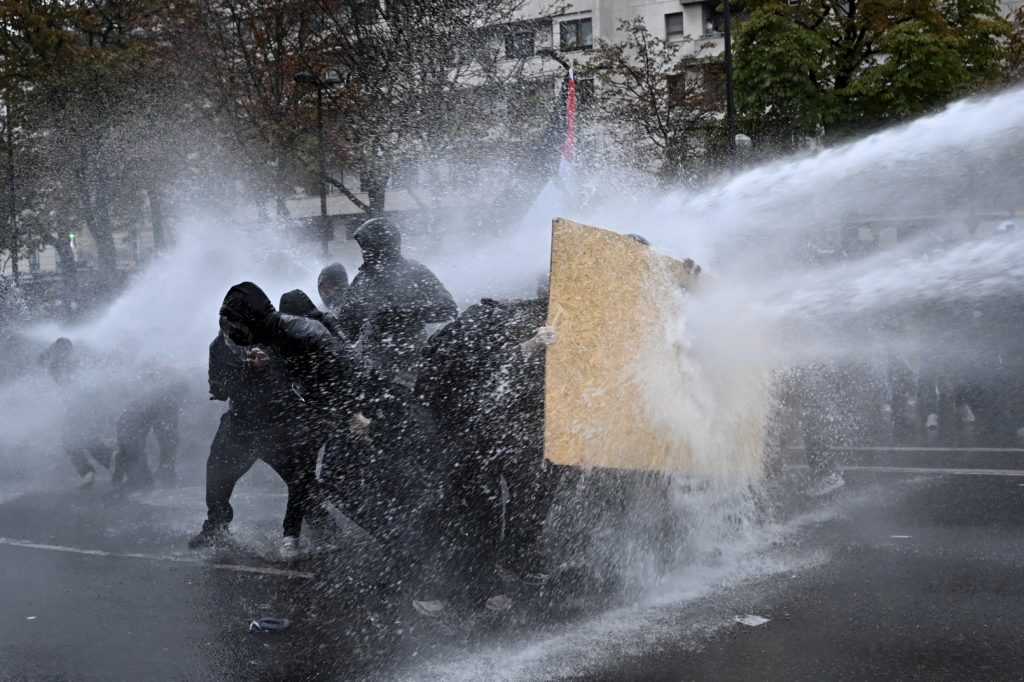
Hundreds of thousands of demonstrators marched through French cities on Saturday during a second consecutive weekend of nationwide unrest over deteriorating public services and escalating living costs. While daytime rallies organized by labor unions remained predominantly peaceful, violent skirmishes erupted as evening fell, prompting riot police to fire tear gas, deploy stun grenades, and unleash water cannons to disperse breakaway crowds in major metropolitan centers[3].
The demonstrations presented a formidable domestic test for President Emmanuel Macron, whose administration mobilized an extraordinary security apparatus to prevent a recurrence of the destructive riots that shook France a week earlier. French Interior Minister Laurent Nuñez announced late Saturday that security forces had arrested nearly 1,000 individuals nationwide, warning that the figure would rise as police processing continued into Sunday morning.[5]
Massive Mobilization and Disputed Crowd Numbers
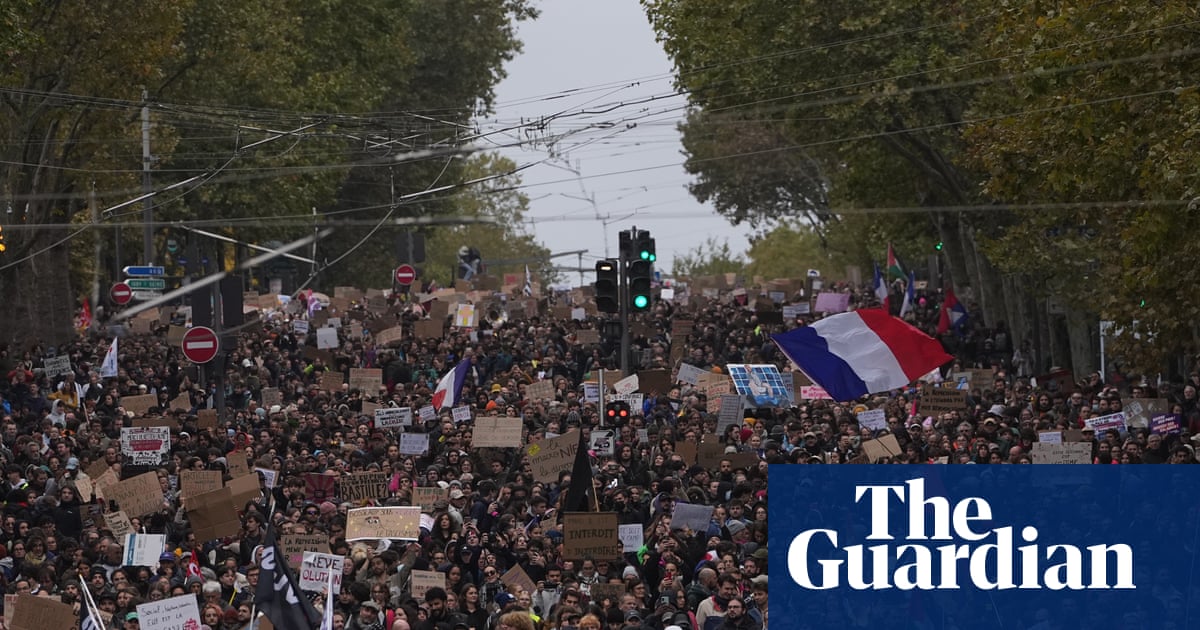
The scale of public discontent remained vast across the country, though official estimates and organizers offered widely divergent attendance figures. According to the French Interior Ministry, roughly 410,000 people took part in approximately 298 rallies nationwide, including 110,000 in Paris. In contrast, the General Confederation of Labor (CGT), one of France's largest trade unions, estimated total turnout at nearly 800,000 across France, asserting that 250,000 people rallied in the capital alone.
The crowds reflected an expanding coalition of grievances. What initially began more than a month ago as secondary school walkouts over staff shortages and deteriorating classroom facilities broadened into a cross-sector movement incorporating hospital staff, transport workers, and ordinary citizens squeezed by stubborn inflation. Demonstrators carried banners demanding wage increases, expanded school funding, and lower consumer costs. Many also carried signs protesting state heavy-handedness, declaring that the right to assemble had come under intolerable assault.
Heavy Security and Containment Tactics
Determined to avoid the chaotic scenes of October 17, when an estimated 3,000 storefronts were damaged or ransacked and roughly 2,700 arrests occurred, the government mounted one of its largest security deployments in recent years. The Interior Ministry put 70,000 police officers and gendarmes on duty nationwide, supported by aerial surveillance helicopters, specialized tactical units, canine squads, and armored crowd-control vehicles.[7]
In Paris, police restricted the primary authorized march route to the southeastern perimeter between Porte d'Italie and Porte de Vincennes, strictly forbidding demonstrators from entering historical central boulevards. Cultural landmarks, including the Louvre Museum, were shuttered across the capital as merchants along potential rally corridors boarded up display windows.[12] Nuñez told reporters that police performed thousands of preemptive stops, confiscating fireworks, steel balls, slingshots, lead pellets, improvised batons, and airsoft weapons before crowds fully formed.
| Metric | Interior Ministry Estimate | Trade Union (CGT) Estimate |
|---|---|---|
| Nationwide Attendance | 410,000 | 800,000 |
| Paris Turnout | 110,000 | 250,000 |
| Nationwide Arrests | Nearly 1,000 | Not Reported |
| Security Deployment | 70,000 Officers | Not Reported |
Clashes in Paris and Regional Strongholds
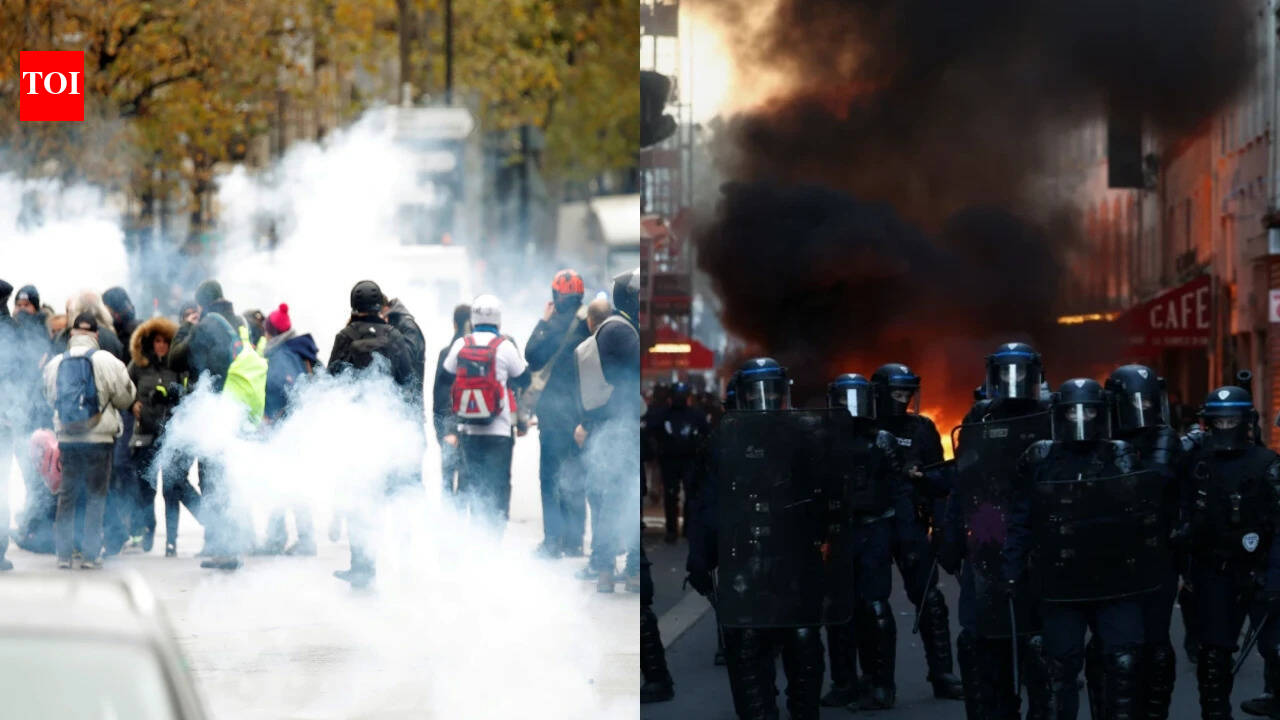
Despite heavy restrictions, order broke down toward the tail end of several processions. As the Paris march reached Porte de Vincennes, hooded demonstrators dressed in black broke from the rear of the authorized march and pelted police lines with glass bottles, rocks, and firework mortars. French authorities reported that approximately 500 radical rioters sought confrontations with law enforcement, prompting riot squads to charge the perimeter with batons and discharge repeated volleys of tear gas.
In almost every march we saw the formation of these high-risk groups. They broke away from the main body and sought to commit acts of violence.
Laurent Nuñez, French Interior Minister
Violence also ignited outside Paris. The Associated Press reported that police deployed tear gas and water cannons against rowdy demonstrations in Lyon, Nantes, Clermont-Ferrand, Toulouse, Bordeaux, and Strasbourg. In Marseille, youths dragged metal panels into roadways, torched refuse bins to build burning barricades, and looted two boutique jewelry shops, according to municipal police reports. N[15]uñez confirmed that at least two protesters suffered severe physical trauma during the unrest: one demonstrator in Clermont-Ferrand and a 20-year-old in Toulouse who reportedly lost several fingers to a blast weapon.
Political Repercussions in Macron's Final Lap
The weekend's sustained mobilization carries acute political stakes for Macron, who faces a narrowing window of authority ahead of the May 2027 presidential election. Opposition figures on both sides of the political spectrum seized on the protests to lambast the Elysee Palace. From the far-right National Rally, allies of Marine Le Pen accused Macron's administration of failing to maintain basic public safety and called on frustrated citizens to demand a change of national leadership. From the left, France Unbowed leader Jean-Luc Mélenchon praised the demonstrator turnout and condemned the government's policing strategy, arguing that aggressive crowd dispersion tools inflict permanent harm on peaceful student protesters.
The Financial Times noted that the continuing wave of marches reflects a deep institutional fragility, leaving the French executive caught between containing street unrest and responding to economic distress that shows little sign of dissipating. Whi[17]le the vast deployment of 70,000 officers largely curbed the rampant destruction seen a week prior, the sheer volume of demonstrators and nearly 1,000 arrests underscore that the social crisis gripping France remains unresolved.
Video
France: Protests continue while police fire tear gas at demonstrators • FRANCE 24 English →