
Nearly nine years after first teasing the second-generation Roadster, Tesla staged an elaborate outdoor demonstration in Texas that pushed the electric supercar beyond conventional automotive boundaries. In a nighttime stunt show streamed across social media, an unmanned prototype of the Tesla Roadster utilized active underbody suction fans to drive completely upside down before deploying high-pressure cold-gas thrusters developed alongside SpaceX to flip in midair and touch back down to earth[1].
The showcase represented a sharp pivot in how Tesla positions its halo performance vehicle, refocusing attention away from commercial delivery delays and toward extreme, aerospace-derived novelty. With Chief Executive Elon Musk declaring on stage that flying cars are finally real, the demonstration sparked immediate awe across the automotive sector alongside profound skepticism from engineering analysts and safety regulators regarding whether such extreme mechanics can legally or practically transition to customer driveways.
Defying Gravity with Fans and Rocket Jets
The outdoor display took place at the SpaceX rocket development and testing facility in McGregor, Texas, an open-air venue chosen specifically because the vehicle maneuvers required ample clearance and blast margins. Rather than navigating a standard test track, the white coupe ascended a towering curved ramp designed to invert the vehicle. According to reporting by Car and Driver, the prototype clung to the arched surface using an active ground-effect fan system capable of producing up to 2 g of vertical suction force.
Once inverted at the top of the ramp, the vehicle detached into open air. In a release observed by CNN, a network of cold-gas thruster nozzles fired powerful bursts of compressed air to reorient the car via attitude control, executing a controlled barrel roll before landing squarely on its tires amidst clouds of vented gas. In a subsequent stunt, the car used the thruster system to leap entirely over a parked lineup of company hardware, including a Cybertruck, a Cybercab, a Tesla Semi, a Model Y, and a Model 3[10].
Flying cars are real.
Lars Moravy, Vice President of Vehicle Engineering at Tesla
Tesla Vice President of Vehicle Engineering Lars Moravy confirmed during the presentation that the prototype relied on 10 perimeter cold-gas nozzles connected to high-pressure composite overwrapped pressure vessels (COPVs) storing roughly 600 liters of compressed air. The company explained that the car uses onboard compressors to replenish its high-pressure reservoirs over time, avoiding chemical propellants while borrowing directly from orbital Falcon 9 reaction control architecture[12] [13].

Speed Benchmarks and Configuration Tiers
Beyond the aerial acrobatics, the company used the showcase to revise the theoretical specifications of the Roadster, which had previously targeted a two-second threshold when announced in 2017. During an acceleration segment highlighted by Autoblog, Tesla demonstrated a zero-to-60 mph launch in a claimed 0.81 seconds, using rearward cold-gas thrust to bypass the physical grip limits of conventional tire rubber.
Following the event, Tesla updated its vehicle portal to outline three distinct trims that dictate how much rocket technology customers might receive, summarized below:
| Variant | Seating Capacity | Claimed 0 to 60 mph | Hardware Integration |
|---|---|---|---|
| Performance | 2 seats | Under 1.6 seconds | Active aerodynamic fan suction system |
| Thrust | 2 seats | Under 0.9 seconds | Rear-mounted cold-gas boost thrusters |
| Rocket | 1 seat | Under 0.59 seconds | Full-perimeter attitude control thrusters |
As detailed by Electrek, the top-tier Rocket specification sacrifices passenger space entirely, replacing the secondary seating and cargo capacity with the massive pressure tanks, high-flow valving, and plumbing required to achieve brief hops and pitch adjustments. Tesla claims this flagship edition can surpass 230 mph while retaining an electric driving range of more than 300 miles between charging cycles[11].
Regulatory Obstacles and the Public Road Dilemma
Despite the spectacle, the demonstration highlighted an enormous gulf between an unmanned testbed performing controlled stunts and a road-certified passenger car. Throughout the demonstration, no human driver sat inside the vehicle. Elon Musk openly acknowledged the danger on stage, quipping to attendees that keeping the cabin empty ensured they would not hurt anyone if the landing thrusters misfired.
The legal viability of the car remains the most glaring unanswered question. When pressed by audience members on whether the thruster-equipped car could legally travel on public asphalt, Musk equivocated, suggesting that street legality would depend on the jurisdiction. Fine print on Tesla's own website clarified that the extreme Rocket trim with flight-capable thrusters is explicitly not approved for public road use, relegating its aerobatic stunts to private property and track environments[5] [19].
Automotive safety researchers and aviation authorities face entirely novel questions with a vehicle of this design. As analysis from Wired pointed out, federal transportation overseers and the Federal Aviation Administration have stringent, incompatible mandates regarding high-pressure vessels, unshielded air blasts, pedestrian safety, and low-altitude flight paths. Discharging explosive bursts of compressed air on a public road would present obvious hazards to surrounding motorists and pedestrians, while storing thousands of pounds per square inch of gas pressure creates acute structural risks in highway collision scenarios.
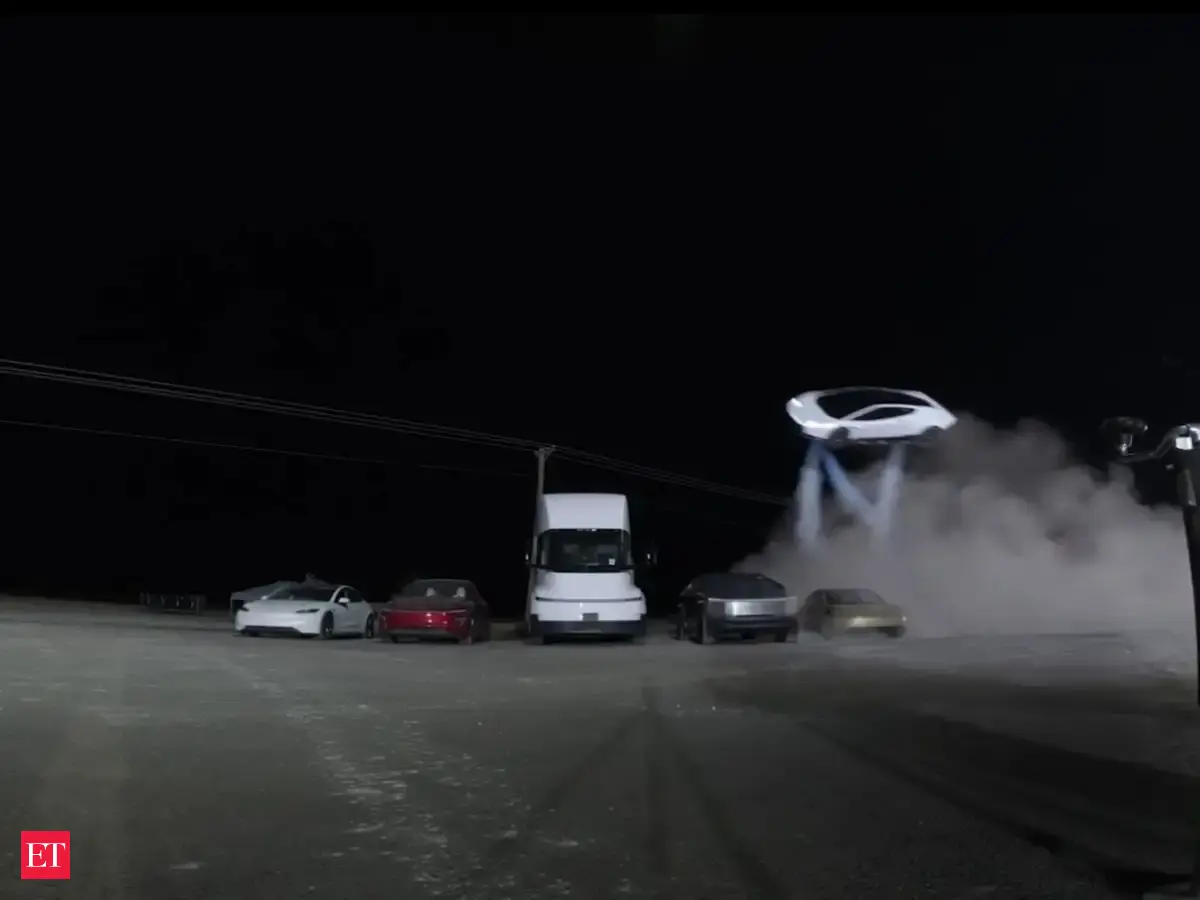
Timeline Realities After a Decade of Delay
The grand Texas unveiling arrives at an awkward juncture for Tesla's core product lineup, which is navigating increasing global EV competition, slowing growth, and repeated production postponements. The second-generation Roadster was originally promised to hit the market in 2020 at a starting price of roughly $200,000. With production now tentatively guided for 2028 at Gigafactory Texas, prospective buyers who placed $50,000 deposits years ago face an eventual eleven-year wait[11] [12].
Tesla has re-opened reservations on its portal, but it notably declined to provide updated retail pricing for the thruster-equipped models. While the company demonstrated that SpaceX thruster components can mechanically toss an electric car through the Texas air, transforming an experimental stunt car into an insurable, mass-produced hypercar stands as one of the most improbable engineering promises Tesla has ever mounted.