A New Era of AI Oversight Dawns
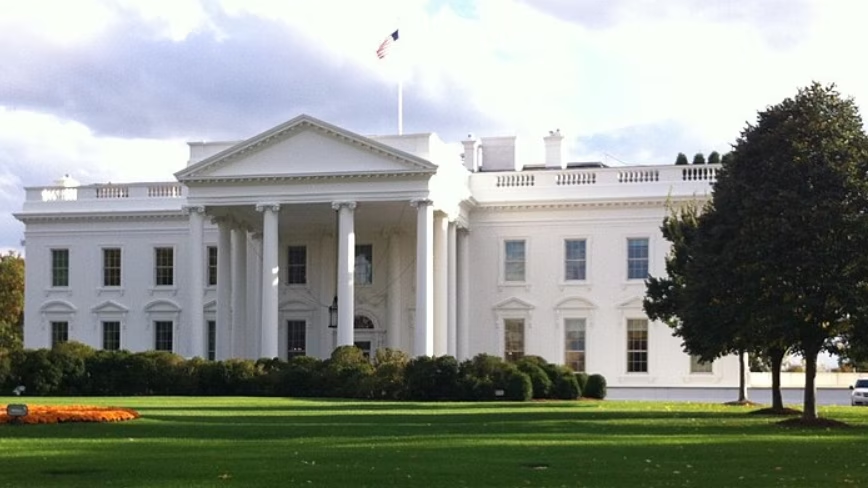
The Trump administration has fundamentally altered the landscape of artificial intelligence development in the United States, taking direct control over which companies and entities gain access to advanced frontier AI models from leading labs such as Anthropic and OpenAI. This marks a significant shift from the previous model where these tech giants independently decided access to their most powerful AI tools. The move signals a broader Washington approach that increasingly treats advanced AI as a strategic national resource requiring government oversight.
This transfer of power became evident with the launch of the White House's new Gold Eagle program, an AI clearinghouse for cyber vulnerabilities. According to CNBC, this program will put the White House in charge of greenlighting which companies can access new AI models. While a White House official stated that company participation is "voluntary" and the government does not "provide approvals for AI releases," the administration has already demonstrated its willingness to intervene.
From Voluntary Framework to De Facto Regulation
The origins of this shift can be traced back to a June 2, 2026, executive order signed by President Trump, titled "Promoting Advanced Artificial Intelligence Innovation and Security." This order requested AI developers to provide federal agencies with up to 30 days of pre-release access to any model designated as a "covered frontier model" for evaluation. The order also directed agencies to collaborate with model developers in selecting external partners for early access to these models, aiming to strengthen the cybersecurity of critical infrastructure.
Despite the official stance that these interactions are voluntary and do not constitute a mandatory licensing or preclearance regime, the operational reality suggests otherwise. For instance, the White House blocked the release of Anthropic's Claude Mythos 5 and Fable 5 models last month due to national security concerns. Access was only reinstated after weeks of negotiations, demonstrating the administration's newfound authority. Similarly, OpenAI stated in June that it would limit new models to "trusted partners" to comply with government requests.
National Security and the AI Race
The primary driver behind this increased government control is national security, with concerns about securing frontier AI against potential exploitation. The administration is also grappling with the rapid advancements of foreign rivals, particularly Chinese labs, which are quickly closing the capability gap in AI. The launch of Moonshot AI's Kimi K3, which reportedly matched or exceeded Fable and GPT-5.6 on independent benchmarks, highlights the urgency of this competition.
Critics, including former White House AI czar David Sacks, have voiced concerns that this new level of government intervention could hinder American innovation and cause the U.S. to lose the AI race. Sacks stated that "the rest of the world won't play by our rules if we bog ourselves down." The lack of clear and public standards for what constitutes a "safe" or "dangerous" model, coupled with the absence of transparent processes for challenging White House decisions, raises significant questions about potential abuse of power and the stifling of innovation.