Z.ai Unveils GLM-5 as Next-Generation Model for Agentic Engineering
Z.ai, the organization behind the GLM family of models, has introduced GLM-5, its latest flagship large language model specifically engineered for complex systems engineering and long-horizon agentic tasks. The release marks a substantial step forward in scaling and capability, transitioning from what the company describes as "vibe coding" toward more reliable, production-grade agentic workflows.
According to the official announcement, GLM-5 significantly expands on its predecessor. Compared to GLM-4.5, the new model scales from 355 billion parameters (32 billion active) to 744 billion parameters (40 billion active), while the pre-training dataset grows from 23 trillion tokens to 28.5 trillion tokens. The architecture also incorporates DeepSeek Sparse Attention (DSA) to reduce deployment costs without sacrificing long-context performance.
Benchmark Performance and Capabilities
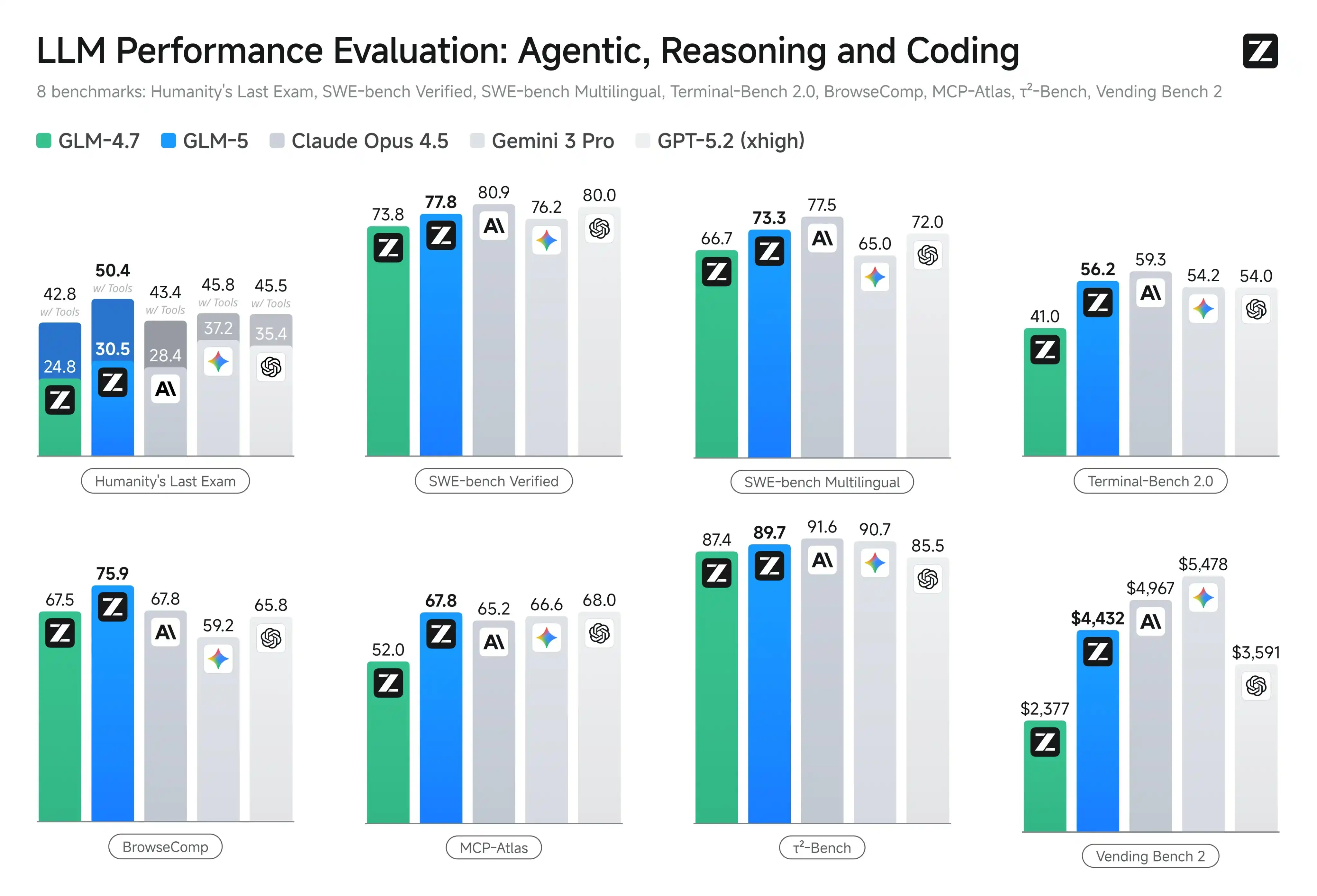
Z.ai evaluated GLM-5 on its internal CC-Bench-V2 suite, where it significantly outperforms GLM-4.7 across frontend development, backend systems engineering, and long-horizon tasks. Reports indicate strong results, including frontend build success rates reaching 98% in tested scenarios. The model narrows the performance gap with top proprietary systems such as Claude Opus 4.5.
In the Vending Bench 2 evaluation — a challenging simulation requiring long-term planning and resource management to operate a virtual vending machine business over a one-year period — GLM-5 secured the top position among open-source models. It concluded with a final account balance of $4,432, approaching the results of Claude Opus 4.5 and demonstrating superior capabilities in sustained operational decision-making.
These results position GLM-5 as the leading open-source model in agentic and software engineering benchmarks, while highlighting continued progress toward closing the divide with frontier proprietary models.
Availability, Rollout, and Open-Source Release
GLM-5 is being released with open weights under the MIT License, available on Hugging Face and ModelScope. Developers can access the model through Z.ai's API platforms and compatible tools, including support for Claude Code workflows.
For existing subscribers, the rollout is phased due to compute constraints. Coding Plan Max users can enable GLM-5 immediately by updating the model identifier (for example, to "GLM-5" in configuration files). Support for other plan tiers will expand progressively. Z.ai noted that requests to the new model consume more quota than previous versions such as GLM-4.7.
Community response has included rapid support for local deployment. Unsloth AI promptly released GGUF quantized versions, enabling users to run GLM-5 on consumer hardware. Positive reactions from open-source advocates contrast with some user feedback regarding subscription adjustments and increased quota usage.
Implications for AI Development
The launch of GLM-5 underscores ongoing scaling efforts in open-source AI and the growing viability of agentic systems for real-world engineering challenges. By combining larger scale with efficiency optimizations like DSA and advanced reinforcement learning infrastructure (including the "slime" asynchronous RL system referenced in technical materials), Z.ai aims to deliver more reliable long-term autonomous performance.
While the model demonstrates clear gains on internal and specialized benchmarks, full independent verification across all claims continues as the community tests the released weights. The availability of open weights under a permissive license is expected to accelerate experimentation and fine-tuning by developers worldwide.
GLM-5 represents the latest milestone in Z.ai's efforts to advance accessible, high-capability AI systems capable of tackling increasingly complex, multi-step tasks.